
Diffused Aeration System
Fine and coarse bubble aeration systems with blowers, headers and DO control for ASP, MBBR, SBR, MBR and aerobic wastewater treatment.
Request a quote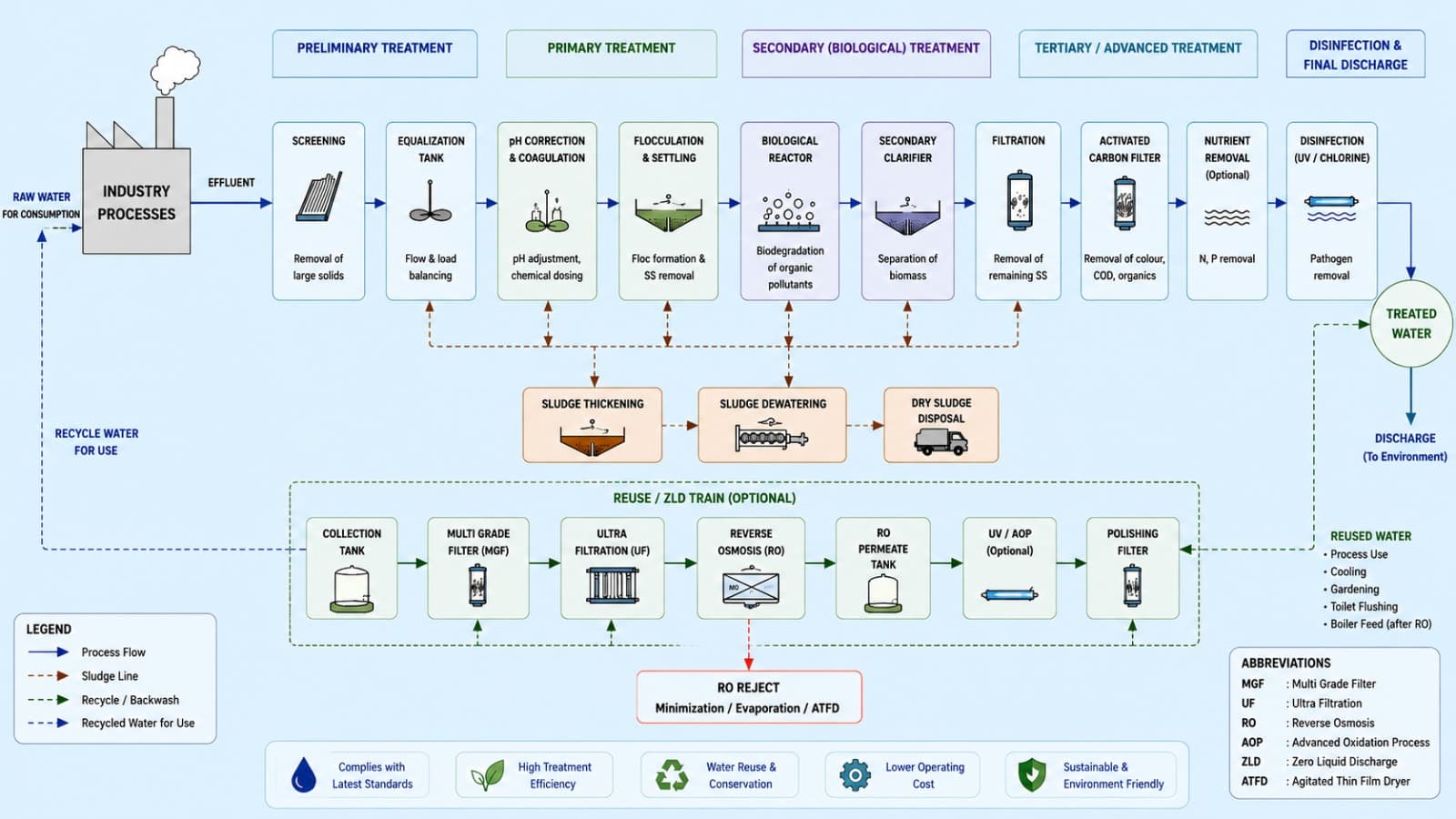
Overview
What Is a Diffused Aeration System?
A diffused aeration system is the submerged air distribution package used to transfer oxygen into wastewater and keep biological tanks properly mixed. It normally includes air blowers, main air headers, branch laterals, fine bubble or coarse bubble diffusers, isolation valves, non-return valves, pressure instruments and dissolved oxygen control. Compressed air leaves the blower, travels through the header network and exits through diffuser pores or slots as bubbles. As the bubbles rise, oxygen dissolves into the mixed liquor and supports aerobic microorganisms that reduce BOD, COD and ammonia.
Why It Is Required
Aeration is required because aerobic biological treatment cannot remain stable without a controlled oxygen supply. The system maintains dissolved oxygen, prevents septicity, keeps biomass and media in suspension, improves contact between wastewater and microorganisms, and helps avoid odour, sludge bulking and incomplete treatment. In plants with variable load, the aeration system is often the highest energy consumer, so correct diffuser selection, blower sizing and DO-based control are essential for treatment quality and operating cost.
Where and When It Is Used
- ASP aeration tanks for activated sludge process oxygen transfer and complete-mix support.
- MBBR tanks for oxygen transfer and carrier-media movement without dead zones.
- SBR basins for timed fill, react, settle and decant cycles with automatic blower operation.
- MBR systems for biological process aeration and coarse bubble membrane scouring below membrane modules.
- Equalization tanks where mixing, odour control and dissolved oxygen maintenance are required before biological treatment.
- Aerobic biological treatment in STP, ETP and industrial wastewater plants handling high organic load.
Main Components
- Fine bubble diffusers: disc, tube or panel diffusers with EPDM, silicone or PTFE-coated membranes for high oxygen transfer efficiency in ASP, SBR, MBBR and process aeration tanks.
- Coarse bubble diffusers: robust diffusers for equalization, grit-prone wastewater, high mixing duty and MBR membrane scouring where air lift and turbulence are more important than maximum OTE.
- Air blowers: twin lobe, tri-lobe, screw or turbo blowers selected for required air flow, discharge pressure, turndown, noise level, standby philosophy and energy performance.
- Air headers and laterals: MS, GI, SS, HDPE, PP or UPVC piping arranged for balanced distribution, isolation, condensate drainage and easy maintenance access.
- Controls and instruments: DO sensors, pressure gauges, flow meters, VFD panels, PLC/SCADA integration, timers and alarms for automatic oxygen control.
Design and Placement Considerations
Diffuser placement is designed from oxygen demand, tank geometry, side-water depth, MLSS, wastewater temperature, alpha factor, mixing requirement and biological process type. Fine bubble diffusers are usually arranged near the tank floor in grids or lateral rows to maximize bubble travel time and uniform oxygen transfer. Coarse bubble diffusers may be concentrated below MBR modules, in equalization zones or in high-solids areas where mixing and fouling resistance are priorities. Header sizing and lateral balancing are checked so that remote diffusers receive adequate air without overloading the nearest zones.
Air Distribution, DO Control and Pressure Drop
A well-designed aeration package keeps pressure drop predictable across blowers, headers, valves, laterals and diffuser membranes. Terraquaer checks static submergence, pipe friction, diffuser headloss, fouling allowance and future turndown before finalizing blower discharge pressure. DO control can be manual, timer-based, VFD-based or PLC/SCADA-based using online dissolved oxygen feedback. This prevents under-aeration during peak organic load and reduces excess air during lean-load operation.
Cleaning and Maintenance
Routine maintenance includes blower oil or belt checks where applicable, air filter cleaning, bearing and vibration checks, valve inspection, header leak inspection, DO probe calibration, diffuser visual inspection and pressure trend monitoring. Rising blower pressure or uneven bubble patterns usually indicate membrane fouling, blocked laterals, condensate accumulation or air imbalance. Diffusers can be cleaned by air bumping, flushing, chemical cleaning or retrieval depending on diffuser type and site arrangement. Terraquaer also supports biological troubleshooting when symptoms such as low DO, foaming, poor settling, odour or high outlet BOD/COD are linked to aeration performance.
Terraquaer Scope
Terraquaer supports aeration design from process requirement to commissioning. The team reviews inlet load, biological process, tank dimensions and existing plant constraints, then selects diffuser type, blower capacity, standby philosophy, header layout, material of construction and control mode. For retrofit plants, Terraquaer can diagnose low DO, high power consumption, clogged diffusers, poor media movement, dead zones and biological instability before proposing corrective work. The scope can include design, supply, installation supervision, commissioning, operator training, DO tuning and long-term O&M support.
SEO, GEO and Internal Linking Signals
- Primary search intent: diffused aeration system, wastewater aeration system, fine bubble diffuser system, coarse bubble diffuser system, STP aeration, ETP aeration, ASP aeration, MBBR aeration, SBR aeration and MBR membrane scouring.
- Recommended internal links: Sewage Treatment Plant, Effluent Treatment Plant, MBBR Media Based Wastewater System, MBR Membrane Based Wastewater Treatment System, Clarifier System and Chemical Dosing Systems.
- Image alt text: Diffused aeration system with fine bubble diffusers, air headers and blower package for wastewater biological treatment by Terraquaer.
- Schema-ready content: Product, FAQPage and Service structured data can describe Terraquaer's aeration design, blower selection, diffuser selection, installation, commissioning and troubleshooting scope.
CTA
Share tank dimensions, inlet BOD/COD, flow, process type and present DO issues with Terraquaer to get a diffuser layout, blower sizing check, air header arrangement and commissioning plan for your STP, ETP, MBBR, SBR, MBR or equalization tank.
Key features
- Fine bubble diffuser grids for high oxygen transfer efficiency in ASP, SBR, MBBR and aerobic biological treatment tanks.
- Coarse bubble diffuser systems for equalization mixing, MBR membrane scouring and high-solids wastewater duties.
- Air blower selection covering flow, pressure, standby requirement, turndown, noise and energy consumption.
- Balanced air headers, branch laterals, isolation valves and pressure instruments for uniform air distribution.
- Manual, timer-based, VFD-based or PLC/SCADA DO control for stable biological performance and lower power use.
- Retrofit support for low DO, clogged diffuser, uneven bubbling, foaming, odour and high outlet BOD/COD issues.
Key outcomes
- Stable dissolved oxygen for aerobic microorganisms and reliable biological BOD/COD reduction.
- Improved mixing in aeration, equalization and biofilm media tanks with fewer dead zones.
- Better oxygen transfer efficiency when diffuser type, submergence and blower duty are matched correctly.
- Reduced aeration energy waste through pressure-drop control and DO-based blower operation.
- Easier operation and maintenance through accessible headers, valves, pressure checks and cleaning provisions.
Standards & certifications
Designed with CPHEEO, CPCB and applicable IS process guidance; blower, electrical and material selection finalized as per site duty and local compliance.
Who it's for
STP and ETP owners, process engineers, EPC contractors, plant operators and O&M teams needing aeration design, diffuser replacement, blower selection, DO control or biological troubleshooting for ASP, MBBR, SBR, MBR, equalization and aerobic wastewater treatment tanks.
Related products
.jpeg&w=3840&q=75)


Looking for something specific?
Tell us what you need to spec.
Share your capacity, compliance milestone, and timeline. An engineer responds within one business day.