
Bag Centrifuge
Batch-operated sludge dewatering unit using centrifugal force and a filter bag — suited for ETPs, STPs, and industrial wastewater plants.
Request a quote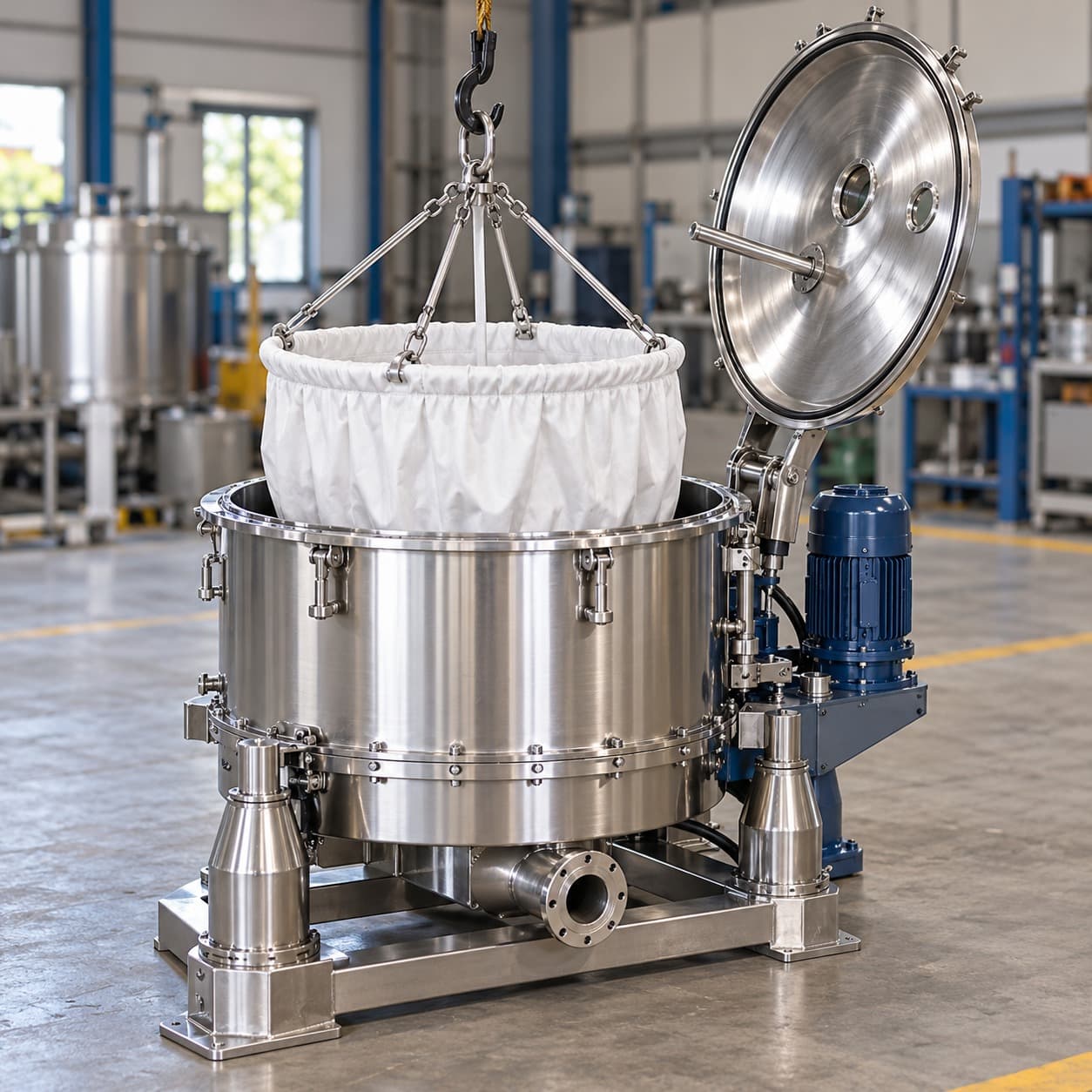
Overview
A Bag Filter Centrifuge is a solid-liquid separation system used in industrial water and wastewater treatment plants to separate suspended solids, sludge, and other particulate matter from process liquids. Depending on the application, a bag filter and a centrifuge may be used as separate filtration and dewatering equipment or integrated into a treatment process to improve solids removal and handling efficiency.
In water treatment applications, bag filters capture suspended particles as water passes through a replaceable filter bag, while centrifuges use centrifugal force to separate solids from liquids. These technologies support pretreatment, polishing filtration, sludge management, and wastewater treatment operations across a wide range of industries.
Terraquaer offers water treatment solutions designed to meet specific process requirements, including filtration efficiency, flow rate, particle size, solids concentration, and operating conditions.
Working Principle
The working principle depends on whether the application uses a bag filter, a centrifuge, or both.
1. Bag Filtration: Water or process liquid enters the filter housing and passes through a specially selected filter bag. Suspended particles are retained inside the bag, while the filtered liquid flows through the outlet.
2. Centrifugal Separation: The liquid-solid mixture is introduced into a centrifuge, where rotational force separates solids from the liquid phase according to differences in density and particle characteristics.
3. Solids Collection: Retained particles or separated sludge are collected for removal, further dewatering, recovery, or disposal, depending on the process.
4. Treated Liquid Discharge: The filtered or separated liquid moves to the next treatment stage, such as activated carbon filtration, membrane treatment, polishing, or reuse.
Key Features
- Effective Solid-Liquid Separation: Helps remove suspended particles and separate solids from process liquids.
- Replaceable Filter Bags: Allows convenient replacement and selection of suitable filtration media.
- Application-Specific Filtration: Filter bags can be selected according to micron rating, material compatibility, and operating conditions.
- Improved Process Protection: Helps reduce the particulate load entering downstream equipment when correctly sized and operated.
- Industrial Process Compatibility: Suitable for integration into selected water treatment and wastewater treatment systems.
- Support for Sludge Management: Centrifugal separation can help reduce the liquid content of suitable sludge streams.
- Flexible System Configuration: Equipment selection can be adapted to flow rate, solids loading, liquid properties, and plant layout.
Applications in Water and Wastewater Treatment
Bag filters and centrifuges can support different stages of industrial water treatment, depending on process requirements.
- Industrial Effluent Treatment Plants (ETP): Removal of suspended particles and support for process-liquid clarification.
- Sewage Treatment Plants (STP): Filtration or sludge dewatering applications where the equipment is suitable for the solids characteristics.
- Reverse Osmosis (RO) Pretreatment: Bag filtration to reduce suspended particulate matter before membrane treatment.
- Cooling Water Systems: Removal of particulate contaminants from selected circulating or process-water streams.
- Chemical Processing Industries: Separation of suspended solids from compatible chemical solutions.
- Manufacturing Industries: Filtration of process water, wash water, and liquid streams containing recoverable solids.
- Sludge Dewatering: Centrifuges can be used to separate water from suitable sludge, reducing the volume of material requiring further handling.
Benefits of Using Bag Filters and Centrifuges
1. Improved Filtration Performance
A properly selected bag filter can capture particles within its specified performance range, helping improve the quality of the filtered liquid.
2. Protection of Downstream Equipment
Reducing suspended solids can help protect pumps, valves, heat exchangers, and membrane systems from particulate accumulation and related operational problems.
3. Simplified Maintenance
Bag filters allow used filter bags to be replaced when loaded or when the differential pressure reaches the recommended limit.
4. Better Sludge Handling
For suitable sludge streams, centrifuges can reduce moisture content and produce a more manageable solids output.
5. Process Flexibility
Different filter media, micron ratings, housing materials, and centrifuge configurations can be selected to suit specific industrial applications.
6. Support for Water Reuse
Effective solids removal can contribute to a multi-stage treatment process intended to prepare water for reuse, subject to the required water quality and additional treatment stages.
Important Selection Considerations
Selecting the correct equipment is essential for reliable operation and consistent treatment performance. Key considerations include:
- Required flow rate and operating pressure.
- Type, size, and concentration of suspended solids.
- Filter bag micron rating and filtration efficiency.
- Chemical compatibility of the filter media and housing.
- Operating temperature and liquid viscosity.
- Expected solids loading and filter replacement frequency.
- Centrifuge type, capacity, and sludge characteristics, where applicable.
- Maintenance access, automation requirements, and available installation space.
The appropriate system should be selected after evaluating the actual process conditions and required treated-water quality.
Operation and Maintenance
Regular inspection and preventive maintenance help maintain filtration and separation performance.
- Monitor inlet and outlet pressure and differential pressure across the bag filter.
- Replace filter bags according to the manufacturer's recommendations and operating conditions.
- Inspect the filter housing, seals, and connections for leakage or damage.
- Check the centrifuge for abnormal vibration, noise, wear, and operating deviations.
- Follow equipment-specific procedures for cleaning, lubrication, and preventive maintenance.
- Handle collected solids and sludge in accordance with applicable site procedures.
Centrifuges must be operated with the appropriate guarding, safety interlocks, and manufacturer-approved operating limits.
Why Choose Terraquaer?
Terraquaer provides industrial water and wastewater treatment solutions focused on practical process requirements, equipment suitability, and dependable plant operation. Our approach considers the characteristics of the liquid stream, solids loading, required filtration performance, and downstream treatment requirements to help identify a suitable filtration or separation arrangement.
Whether the requirement involves bag filtration for suspended-solids removal or centrifugal equipment for sludge dewatering, the system configuration should be matched to the specific application.
Conclusion
A bag filter and a centrifuge perform complementary but different functions in water treatment. Bag filtration is primarily used to capture suspended particles, while centrifuges are designed to separate solids from liquids using centrifugal force. When correctly selected and integrated into a treatment process, these technologies can support effective solids management, protect downstream equipment, and improve overall plant operation.
Key features
- Centrifugal force-driven solid–liquid separation using a replaceable filter bag inside a rotating basket
- Batch operation with bag removal for easy cake discharge — no scraper or conveyor required
- Handles wide range of sludge types: ETP, STP, chemical, pharmaceutical, and food-processing sludge
- Low power consumption due to single-motor design and short cycle times
- SS 304 / SS 316L contact parts available for corrosive and food-grade applications
- Filter bag replaceable without dismantling the machine — reduces downtime significantly
- Compact footprint suitable for small to medium capacity wastewater plants
- VFD option available for optimised dewatering across different sludge characteristics
Key outcomes
- Reduces sludge moisture content to 60–75% dry solids — significantly cutting sludge volume and disposal cost
- Eliminates or reduces polymer dosing requirements compared to belt press or screw press
- Fast batch cycle (typically 5–15 minutes) enables high throughput in limited floor space
- Recovered filtrate is clean and can be returned directly to the treatment process
- Lower capital cost vs. decanter centrifuge for small to medium sludge volumes up to 500 LPH
- Minimal operator skill required — suitable for sites with limited technical staff
Standards & certifications
Fabricated to IS/BIS standards for rotating equipment; SS 316L contact parts available for pharmaceutical-grade applications; compatible with CPCB ETP/STP consent conditions for sludge disposal norms.
Who it's for
Plant engineers and EPC contractors at small to medium ETPs, STPs, or industrial process plants needing a cost-effective, low-maintenance sludge dewatering solution where floor space is limited and sludge volumes are up to 500 LPH. Particularly relevant for pharmaceutical, chemical, food and beverage, and textile effluent plants where batch dewatering aligns with batch process operations.
Looking for something specific?
Tell us what you need to spec.
Share your capacity, compliance milestone, and timeline. An engineer responds within one business day.