
Greywater Treatment Plant(GWTP)
A Greywater Treatment Plant recycles household wastewater from showers and sinks for irrigation and toilet flushing, cutting water bills sustainably.
Request a quote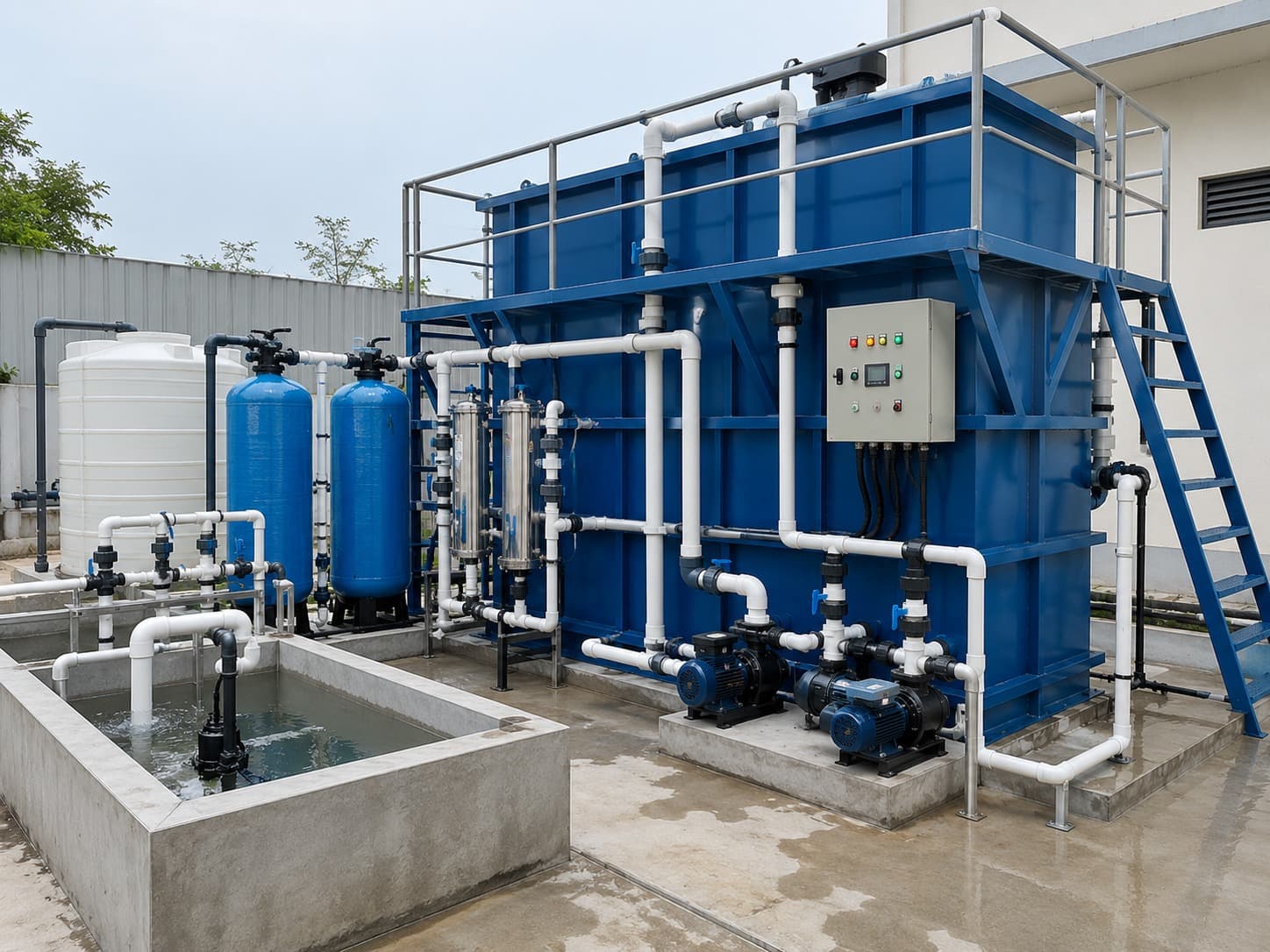
Overview
A Greywater Treatment Plant (GWTP) is a water treatment system designed to collect, treat, and recycle wastewater generated from non-toilet sources such as bathrooms, showers, washbasins, laundry areas, and handwashing facilities. It removes suspended solids, organic impurities, detergents, odour-causing substances, and other contaminants to make the treated water suitable for designated non-potable applications.
Terraquaer offers greywater treatment solutions designed to support efficient water management, reduce freshwater consumption, and promote sustainable water reuse in residential, commercial, institutional, and industrial facilities. The treatment system can be customised according to wastewater characteristics, daily flow rate, available installation space, and the intended reuse application.
By incorporating appropriate physical, biological, and filtration technologies, a greywater treatment plant helps facilities manage wastewater responsibly while improving overall water-use efficiency.
What Is Greywater?
Greywater is wastewater generated from domestic or commercial activities, excluding wastewater from toilets. Its composition depends on the source and may include soap, shampoo, detergents, hair, lint, suspended particles, oils, and biodegradable organic matter.
Common sources of greywater include:
- Bathrooms and shower areas
- Washbasins and handwashing stations
- Laundry and washing machines
- Bathing and washing facilities in hotels, hostels, and residential complexes
- Selected commercial and institutional washing areas
Greywater generally requires appropriate treatment before reuse. Untreated greywater can develop unpleasant odours, support microbial growth, and cause operational issues in plumbing and storage systems. A properly designed treatment plant helps reduce these risks and supports safe, application-specific water reuse.
How Does a Greywater Treatment Plant Work?
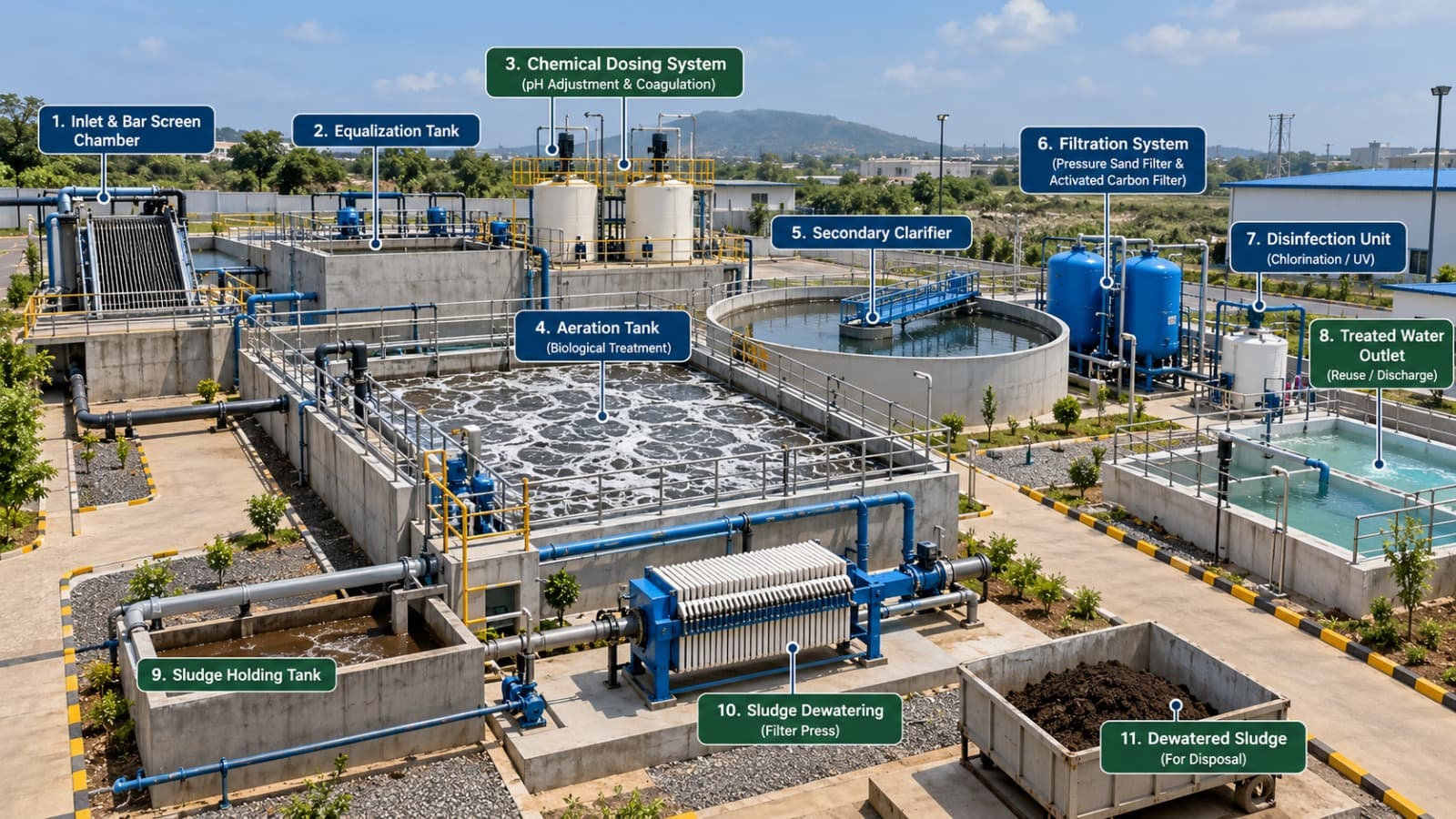
A greywater treatment plant uses a sequence of treatment stages selected according to the quality of incoming wastewater and the required treated-water standards.
1. Collection and Screening
Greywater from designated sources is collected through a dedicated drainage network and conveyed to the treatment plant. Screening removes larger particles such as hair, lint, fibres, and other debris that could clog pumps, pipes, and downstream equipment.
2. Equalisation Tank
The collected wastewater enters an equalisation tank, where variations in flow and pollutant concentration are balanced. This provides a more consistent feed to subsequent treatment units and helps improve process stability.
3. Primary Treatment
Primary treatment removes settleable solids and floating impurities. Depending on the system design, this stage may include settling, separation, or other physical treatment processes to reduce the load on downstream equipment.
4. Biological Treatment
Biological treatment uses microorganisms to break down biodegradable organic pollutants present in greywater. Depending on the required capacity and wastewater characteristics, the system may use technologies such as:
- Moving Bed Biofilm Reactor (MBBR)
- Sequencing Batch Reactor (SBR)
- Membrane Bioreactor (MBR)
- Other suitable biological treatment processes
The selection of biological technology depends on treatment objectives, available space, operational requirements, and the characteristics of the incoming wastewater.
5. Secondary Clarification or Membrane Separation
Where conventional biological treatment is used, a secondary clarifier may separate biological solids from the treated water. In systems using membrane technology, membranes provide solid-liquid separation and help retain suspended matter and biomass.
The selected process depends on the desired effluent quality and overall plant configuration.
6. Tertiary Filtration
Further filtration improves the clarity of treated water and reduces residual suspended particles. Depending on the application, treatment may include pressure sand filtration, activated carbon filtration, cartridge filtration, or membrane filtration.
Activated carbon may help reduce residual odour and certain dissolved organic compounds, depending on the water quality and media selection.
7. Disinfection
Disinfection is applied where required to reduce microbial contamination before reuse. Suitable options may include ultraviolet (UV) disinfection or controlled chlorination, depending on the application, water quality, and storage requirements.
The disinfection system must be selected to meet the intended reuse criteria. Additional controls may be necessary to maintain water quality during storage and distribution.
8. Treated Water Storage and Reuse
After treatment, the water is collected in a treated-water tank and supplied to approved non-potable applications. Where required, the system may include pumping arrangements, level controls, residual disinfectant monitoring, and a dedicated reuse distribution network.
The treated water should not be connected to potable-water lines without appropriate safeguards, and cross-connections between potable and reclaimed-water systems must be prevented.
Key Components of a Greywater Treatment Plant
A typical greywater treatment plant may include the following equipment, depending on the design:
- Collection and screening system: Removes larger debris before treatment.
- Equalisation tank: Balances flow and wastewater characteristics.
- Transfer pumps: Convey wastewater between treatment stages.
- Biological treatment tank: Supports biological degradation of organic pollutants.
- Aeration system: Supplies oxygen where required for aerobic treatment.
- Clarifier or membrane system: Separates solids from treated water.
- Pressure sand filter: Reduces residual suspended particles.
- Activated carbon filter: Helps control residual odour and selected organic impurities.
- Disinfection unit: Reduces microbial contamination when required.
- Treated-water tank: Stores treated water before reuse.
- Control panel and instrumentation: Supports monitoring and operation of pumps, blowers, valves, and level controls.
- Piping and distribution network: Transfers treated water to designated reuse points.
The final equipment configuration depends on plant capacity, wastewater quality, space availability, automation requirements, and the intended application.
Applications of Greywater Treatment Plants
Greywater treatment systems are suitable for a wide range of facilities where non-potable water demand can be met through treated wastewater reuse.
Residential Buildings and Housing Societies
Greywater from bathrooms, washbasins, and laundry facilities can be treated for suitable non-potable applications, helping reduce the demand for fresh water.
Hotels and Resorts
Greywater generated from guest bathrooms, showers, and laundry facilities can be treated for approved reuse applications, subject to wastewater segregation and treatment requirements.
Commercial Buildings and Offices
Treatment systems can support water reuse in buildings with substantial washroom and handwashing wastewater generation.
Hospitals and Healthcare Facilities
Suitable systems can be designed for segregated greywater streams, subject to healthcare wastewater management requirements and appropriate treatment barriers.
Educational Institutions and Hostels
Schools, colleges, hostels, and training facilities can use greywater treatment to support water conservation and responsible wastewater management.
Industrial Facilities
Factories and industrial campuses may treat segregated greywater from washrooms, bathing facilities, and other suitable sources for designated non-process applications.
Public and Institutional Buildings
Airports, railway facilities, community centres, and other public buildings can consider greywater recycling where the wastewater stream and reuse demand are suitable.
Benefits of a Greywater Treatment Plant
1. Reduced Freshwater Consumption
Reusing treated greywater for appropriate non-potable applications can reduce dependence on freshwater supplies.
2. Improved Water Management
The plant supports the recovery and reuse of water that would otherwise be discharged, helping facilities make better use of available water resources.
3. Lower Wastewater Discharge
On-site treatment and reuse can reduce the volume of greywater discharged to the drainage network, depending on actual reuse demand and operating conditions.
4. Support for Sustainable Buildings
Greywater recycling can contribute to water-efficiency initiatives in residential, commercial, and institutional developments.
5. Flexible Treatment Configurations
The system can be designed using conventional biological treatment, compact membrane-based processes, or combinations of filtration and disinfection technologies.
6. Efficient Use of Available Space
Compact and modular configurations may be suitable for sites with limited installation space, subject to hydraulic and operational requirements.
7. Potential Reduction in Water-Related Costs
Replacing a portion of freshwater demand with appropriately treated greywater may help reduce water procurement costs. Actual savings depend on plant operating expenses, energy consumption, maintenance, and reuse volume.
Greywater Treatment Plant Capacity and Customisation
Greywater treatment plants can be designed for different flow requirements, from small buildings to large residential developments and commercial facilities. The appropriate capacity should be determined from the expected daily wastewater generation, peak flow, wastewater characteristics, and treated-water demand.
Important design considerations include:
- Treatment capacity: Average and peak wastewater flow rates.
- Wastewater source: Bathroom, washbasin, laundry, or other segregated greywater streams.
- Influent quality: Suspended solids, BOD, COD, detergents, oils, and other relevant parameters.
- Treated-water requirements: The quality needed for the intended reuse application.
- Available space: Underground, ground-level, or modular installation options.
- Automation level: Manual, semi-automatic, or automatic operation.
- Power and utilities: Electrical supply, aeration requirements, and pumping needs.
- Maintenance access: Space for filter cleaning, equipment servicing, and sludge removal.
- Future expansion: Provision for increased wastewater generation or reuse demand.
The final design should be based on wastewater analysis and the applicable requirements for the intended reuse.
Operation and Maintenance
Regular operation and maintenance are essential to keep a greywater treatment plant performing reliably.
Recommended activities include:
- Inspect screens and remove accumulated debris.
- Check pumps, blowers, valves, and piping for leaks or abnormal operation.
- Monitor tank levels, flow rates, and equipment performance.
- Maintain aeration and biological treatment conditions where applicable.
- Backwash filters according to differential pressure and operating requirements.
- Clean or replace filter media and cartridges as recommended.
- Inspect and maintain membranes according to the selected membrane system.
- Monitor disinfection performance and residual disinfectant where applicable.
- Remove accumulated sludge and dispose of it through an appropriate route.
- Test treated-water quality at a frequency appropriate to the reuse application.
- Maintain operating logs, maintenance records, and water-quality results.
A planned maintenance programme helps identify operating problems early and supports consistent treated-water quality.
Factors to Consider Before Selecting a Greywater Treatment Plant
Before installing a greywater treatment system, consider the following:
- Source segregation: Ensure the collected stream is suitable greywater and is separated from toilet wastewater and other unsuitable discharges.
- Treatment objectives: Define the intended reuse applications and the required water-quality parameters.
- Technology selection: Choose a process suitable for the wastewater characteristics, available space, and operational capacity.
- Reuse demand: Match plant capacity with realistic daily demand to avoid unnecessary treatment and storage.
- Storage and distribution: Provide suitable tanks, separate plumbing, and measures to prevent cross-connections.
- Compliance requirements: Verify applicable local and project-specific requirements for treated-water reuse, discharge, and public-health protection.
- Lifecycle cost: Evaluate capital cost, energy, chemicals, labour, consumables, maintenance, and sludge handling.
Why Choose Terraquaer for Greywater Treatment Solutions?
Terraquaer focuses on practical water and wastewater treatment solutions designed around project-specific requirements. Our approach considers wastewater characteristics, treatment objectives, site conditions, reuse applications, and long-term operational needs.
Our greywater treatment solutions can be tailored to support:
- Treatment plant selection and process configuration
- Capacity assessment and system design
- Integration of biological treatment, filtration, and disinfection
- Pumping, piping, and control-system requirements
- Installation and commissioning support, according to project scope
- Operation, maintenance, and after-sales support, as agreed for the project
The objective is to provide a treatment configuration that is technically appropriate, operationally manageable, and aligned with the facility's water-reuse goals.
Gallery
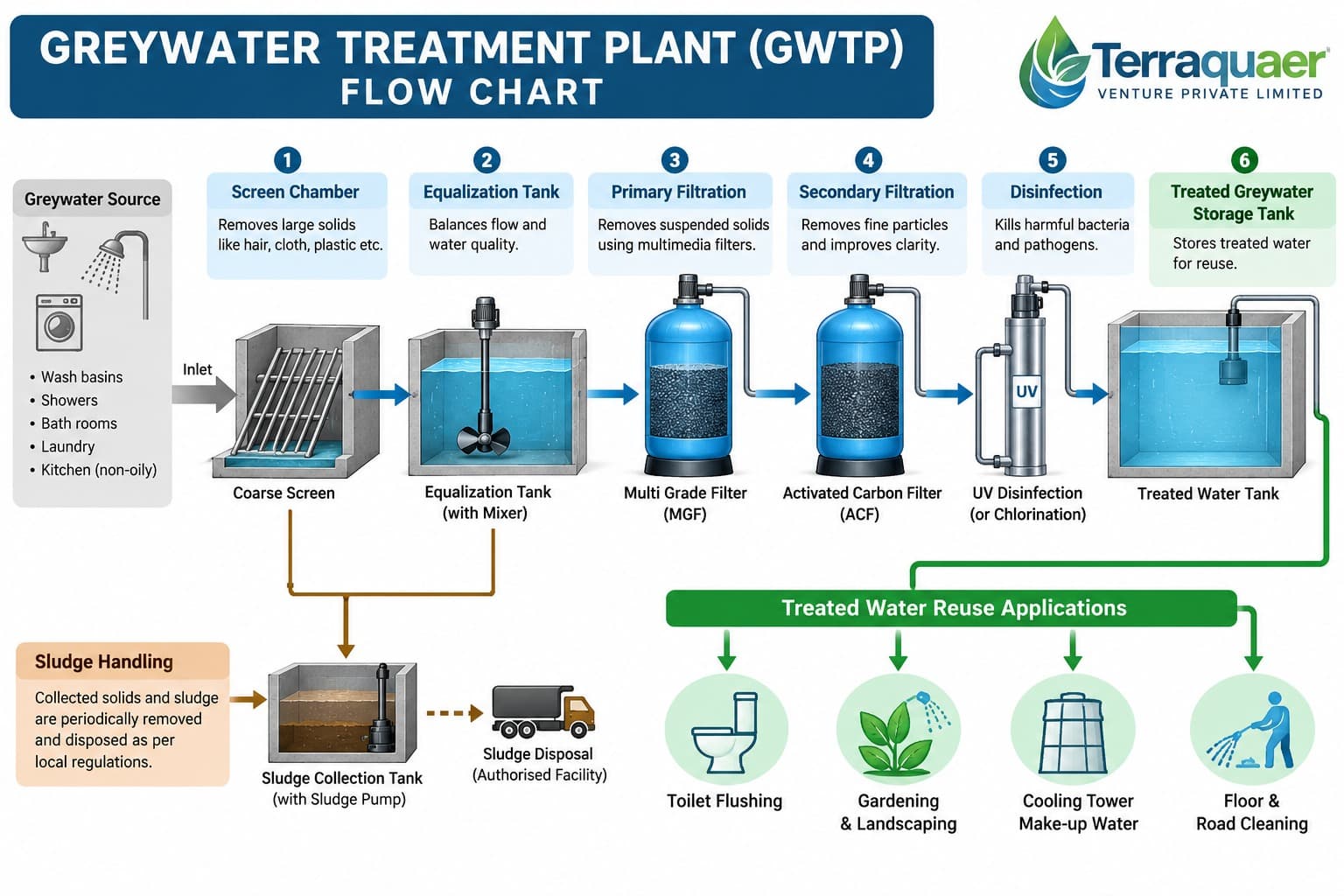
Working of Greywater Treatment plant
Related products
Looking for something specific?
Tell us what you need to spec.
Share your capacity, compliance milestone, and timeline. An engineer responds within one business day.